Brady Smith and Julia Campisi
The Hard Way
November 8, 2025 – January 4th, 2026
Opening reception Saturday November 8, 2025
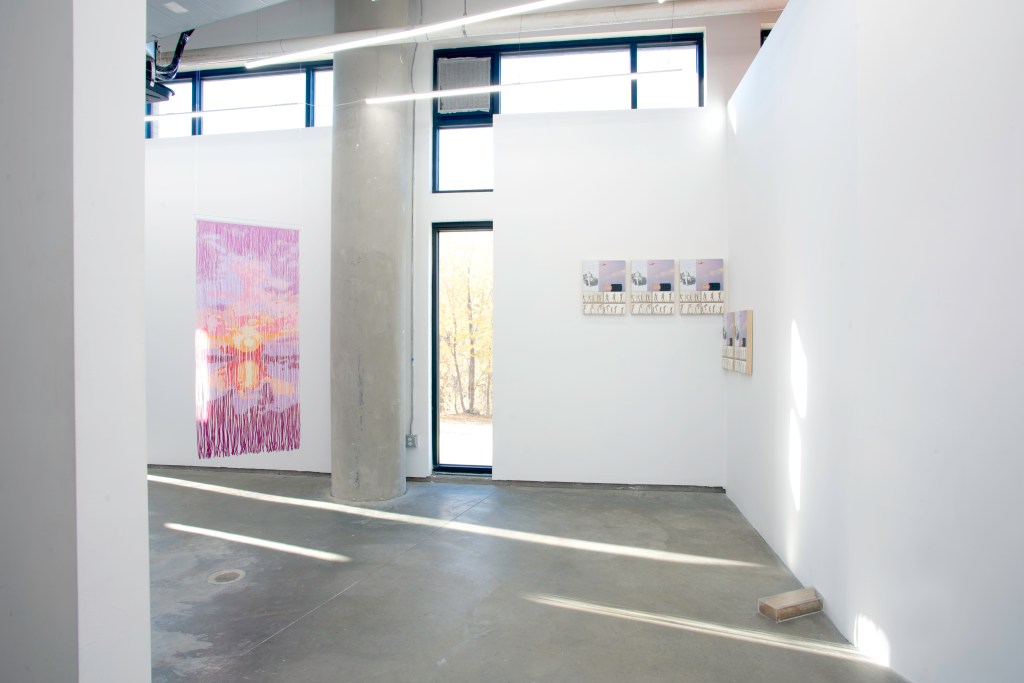
‘The Hard Way’ examines what happens when time refuses to resolve, when memory, labor, and material are asked to hold still long enough to be examined. Featuring the work of Brady Smith and Julia Campisi, the show lingers in a space where objects become evidence, memory is both true and false, and repetition is not a method of replication, but of discovery and repeated labor.
For Campisi, time is archaeological. She extracts everyday forms, bricks that hold walls, curtains that mark thresholds, language that promises inclusion, and strips their function. Once they can no longer fulfill their purpose, they are no longer ordinary. Encased in resin or translated into grids of beadwork, they become contemporary reliquaries: preserved, protected, held in a suspended present. These objects do not say “that was then”; instead they say “this still is.” Underlying this gesture is a quiet distrust of permanence, of safety, of systems that insist on stability.
Smith moves through time from within. His work is rooted in a recurring childhood dream in which he discovers his grandfather’s death by seeing feet protruding from a stack of tires. Feet, tires, and other dream fragments, some real, some invented, recur across his drawings and screen prints. For Smith, memory is not proof but pursuit. It is sometimes false, fragmented, or borrowed, but remains no less real. Time in his practice is also material, stretched across the labor of repetition. Screen printing offers mechanical repetition; drawing demands days of intimate return. He is not interested in sameness or difference, only in what repetition reveals slowly.
Together, Campisi and Smith construct what Smith calls a “deafened conversation.” Not silent, but quieted, muffled enough that viewers must listen with care. Neither offers resolution. Instead, they hold time in tension: collapsed, looped, or suspended. Campisi fixes time inside material; Smith stretches it through labor and memory. One builds reliquaries. The other traces dreams.
In ‘The Hard Way’, meaning is not given. It is worked for, through doubt, persistence, touch. It lives in the residue of what remains when utility fails, when memory falters, when we decide to stay with the uncertainty rather than escape it.
Your message has been sent

 Friend of a Friend