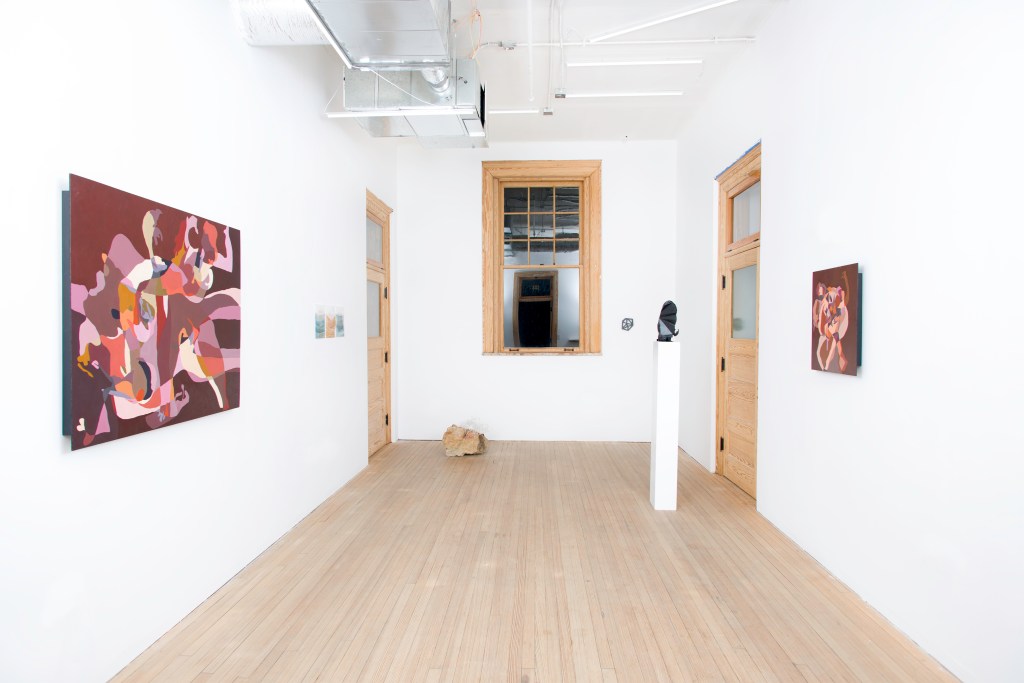
D I G brings together four Colorado based artists who explore physical and metaphorical connections to excavation. Major uprootings are happening all around the world and documenting the layers and history of place, placement, and movement has become a fundamental mode of art making. In the West, and Colorado specifically, people are constantly maneuvering through this state in the form of travel, tourism, outdoor activity or relocation. Earth moves and so do bodies – there is a lack of idleness and there are so many layers to dig through.
Noa Fodrie overlays blind contour drawings and paints colors into the negative space created. The results are earth-toned abstractions that allude to parts of the body in a form of dance with hints of an arm, or a face. Music and choreography are heavy influences with Fodrie’s work and this can be seen within the flow of line and balance of color throughout her compositions. Amy Hoagland transports and transforms environmental situations found in the landscape. From rings of a tree trunk to heavy, dirty rocks, she transposes forms of nature to a new context by melting scientific glass rods in referential shapes likened to icicles and mountains. The combination of these reveal the connections of a shared state of constant flux. Emily Grace King creates encaustic monotype assemblies with wax from beehives she keeps in her backyard. The transformation of her outdoor space requires the moving of dirt and careful attention to the hives to harvest wax. The resulting monotypes allude to translucent canyons and mountainscapes on mylar and vellum hanging delicately in the balance. Fitz Lewis combines analog and digital technologies to excavate heavy themes of trauma, combat, and unacknowledged identities. As a military veteran, Lewis uses many raw war materials like sand, burlap and metal caging with 3-D scanned and printed body parts in multiplicity. The associations created by merging these semi-familiar objects represent the literal barriers that protected them during combat as well as the struggles of post war/post masculine life.
Curated by Derrick Velasquez and Lauren Hartog
 Friend of a Friend