
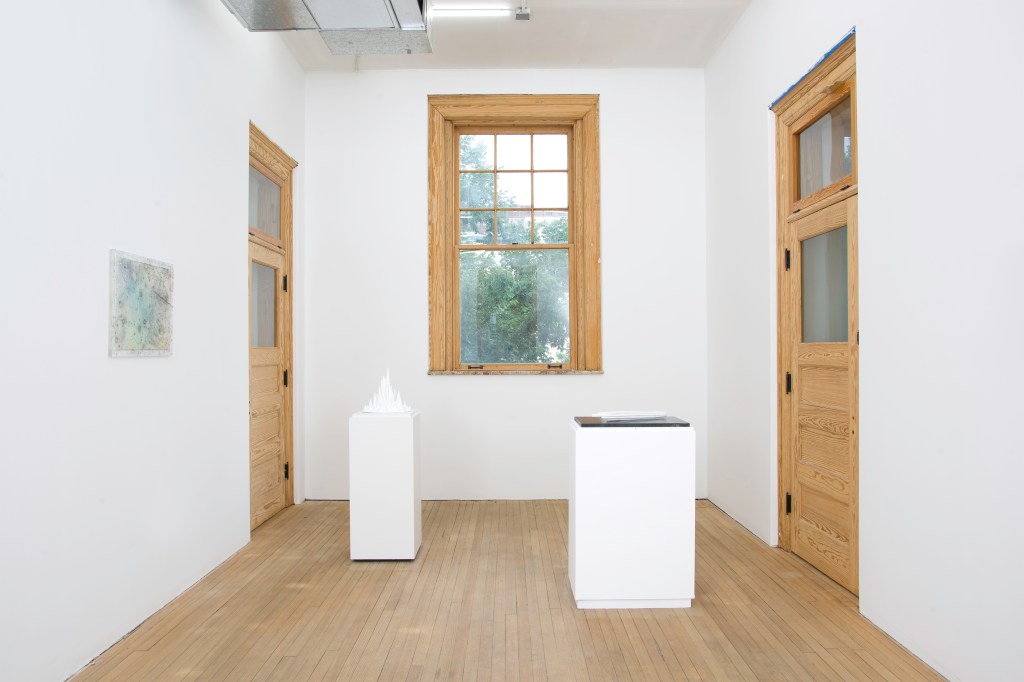
Friend of a Friend Gallery (FOAF) is happy to present To Infinity & Beyond, on view through July 24, 2022. To Infinity & Beyond is an exploration of outer space. Artworks from selected earthbound makers ponder intergalactic happenings in both science and the imagination. Astronomy, comets, asteroids, and more are captured and interpreted by featured artists.
Ashley Eliza Williams’ otherworldly imagery captures fleeting moments of synchronization between humans and the natural world. Williams describes much of her practice as “communication attempts” which aim to encourage and record transmissions between different species or even between living and non-living elements and entities. Much of her work is derived from her experiences as a sensory corpus on Earth, though the images which result are often fantastical. Imagery that defies clear interpretation and evades attempts to pinpoint their origins are commonplace in her practice. Williams’ work in To Infinity & Beyond was imagined after the artist witnessed fireflies in a field. Though the paintings do give us subtle clues as to her inspiration, Williams has carefully rendered in her work an element of eerie unknowing and a sense of disembodiment that somehow separates their subjects from the earthly realm. The vignettes in the resulting pieces then, just as easily read as a galaxy of stars
in the night sky, or scenes from an interplanetary interaction with clouds of glowing cosmic beings.
Interplay between the imaginary and the real are equally important in the work of Laura J. Lawson. Maps and cityscapes are a central component of the artist’s practice. Equally, Lawson is drawn to records of extra terrestrial landscapes. Lawson began using acrylic to produce to-scale replicas of original USGS (United States Geological Survey) satellite images and topography scans of planets and other bodies in our solar system several years ago. Except for those of the Earth’s moon, no human has set foot in the landscapes Lawson depicts. We cannot know the landscape in the intimate ways we know Earth’s until we resume manned missions, nor we currently know how the present terrains cap-tured by the USGS have changed in subsequent decades since they were initially obtained. Often this knowledge gap spans at least five decades. Lawson encourages viewers to “read” these interplanetary maps just as a NASA scientist would. By using her works to compare another planet’s terrain to our own, we imagine the past and future of both places. To relay the untenable nature of our imaginings of these places, Lawson often employs florid colors or plays with the transparency and reflective qualities of the acrylic she employs.
More literal interpretations of the places and spaces surrounding Earth are upheld by the final two artists in the exhibition. Dalila Pasotti often researches the scientific data and theories surrounding the occurrences and principles she portrays in her work. Fascinated by occurrences like nebulae and black holes Pasotti visually interprets these happenings starkly and minimally. Often her works are ironically minuscule in comparison to the seismic proportions of what she is representing. One of the two diminutive sculptures she has produced in To Infinity & Beyond is a comet – an icy, small body that, when passing close to the Sun, warms and begins to release gases that produce the signature coma or tail. Pasotti’s second work, titled Fluctuations, is a visual representation of Heisenberg’s uncertainty principle. First formulated by German physicist and Nobel laureate Werner Heisenberg in 1927, the uncertainty principle states that we cannot know both the position and speed of a particle, such as a photon or electron, with perfect accuracy; the more we nail down the particle’s position, the less we know about its speed and vice versa. The uncertainty principle is often utilized in quantum physics, as well as in quantum astronomy, where it often employed to mathematically represent what is known, and also what unknown about the universe and all of beings and bodies it contains.
Finally, Gretchen Marie Shaefer returns to a subject well known to her practice in her delicately and highly detailed drawings. Shaefer is known for her intense study of rocks and minerals in her wider practice. The graphite and ink renderings Shaefer has produced for “To Infinity and Beyond” have taken her for the first time to extra terrestrial spaces and depict Moon rocks. Faithfully reproducing specimen gathered on lunar missions, Shaefer treats her subjects with measured scrutiny. Leaving no bump or crevice unnoticed, the near life-size works bring viewers into intimate proximity with ancient remnants of a place which is utterly foreign and nearly unfathomable for our Earthly eyes. Eventually Shaefer will include parts of this series in Astromaterials 3D, a virtual library created by fellow artist Erika Blumenfield and NASA that catalogs and studies NASA’s private collection of space rocks. The titles of Shaefer’s works reflect the origins and records of the particular specimen she depicts.
Curated by Derrick Velasquez and Lauren Hartog
 Friend of a Friend