Friend of a Friend Gallery (FOAF) is happy to announce Void, on view February 19 through March 20, 2022. Void explores vacuums, absence, chasms, and gaps. Viewers are confronted with works that reflect on loss, extinction or decay, disassociation, or evoke the sense there are gaps or lapses in our perception of them. The featured artists use a variety of media and conceptual frameworks that meditate on what these themes mean for them in their practice and lived experience.
Rose Dickson’s intimate works exist in a Jungian dream-place. Elemental forms are further shrouded by the inclusion of a layer of beeswax the artist finishes much of her works with. Underneath the wax layer, the graphic markings she renders seem almost to shimmer or subtly move as one moves about the works. The disarming pitch black planes seem at once foreboding and familiar, their depths calling to our shadow selves and urging us to take a closer look. Dickson’s works often use unspecified, archetypal imagery to create a spiritual viewing experience.
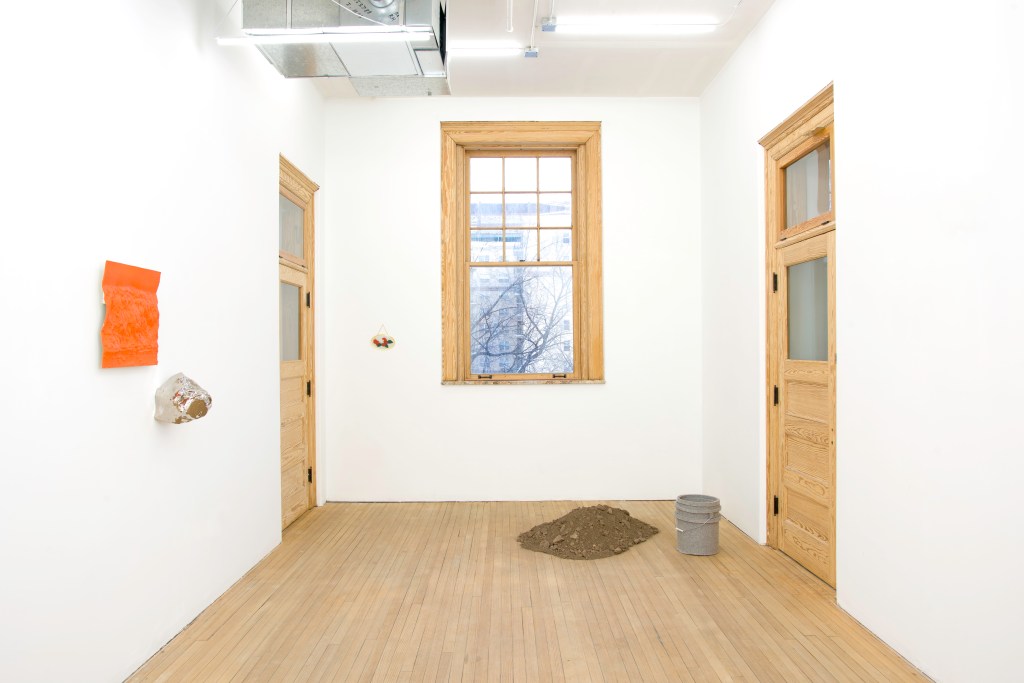
Created from field research done in the Arctic Circle, Mia Mulvey’s 78 degrees latitude refers to the farthest point north she was able to reach before being blocked by ice. These pieces which comprise the work are created from photographs and 3d scans of glacial ice long since melted and disappeared into the ocean.The arctic and its inhabitants are slowly melting into obscurity as our warming planet encroaches further and further to the point of no return. Mulvey declares the urgency of our situation in florid hues, which provide further contrast to her works’ fragile materiality.
Just as Mulvey’s work aims to commit to memory what is fast disappearing, Tobias Fike’s installation is borne from a ritual of remembrance of his late friend. For over ten years, Fike has kept dirt gathered from an earlier commemorative performance which saw the artist remove earth from the ground in an amount equivalent to his friend’s weight at death. This dirt has become a stand-in for a physical body, an entity that he has kept with him and painstakingly begun to transfer to gel pill capsules. Fike creates one capsule for every day his friend has been gone. Displacing his grief and memories onto the dirt and into the capsules has emphasized the deceased‘s absence. Poignantly, the artist has confessed he is currently “behind” on his encapsulation ritual, having forgotten to complete it for a matter of months as time further distances him from the event of his friends passing and memory.
The body and its image, to oneself and others, is a central point of contention in the work of Melanie Issaka. “Locating The Personal’ investigates visibility and colonial alienation within the Black community. A series of self-portraits, this body of work aims to question the representation of the Black Female figure within the photographic canon. Exploring the spaces she occupies and generates, confronting the materiality of her hair and body, Issaka creates imagery which blurs the lines between the self and the other. Through encounters with material, the artist marks her presence and claims space in a society that often dehumanizes Black bodies. Created in Issaka’s bedroom during quarantine, the artist’s photograms created a self awareness of emotions as a bodily surface. On her own terms, in moments of illumination, sheboldly exposes herself.
An often overlooked and increasingly rare craft, hand lettering and signs occupy that strange no man’s land between art and design. As signs are nearly ubiquitous, something we encounter on a day to day basis, it is bizarre to consider how their creation, or more aptly in today’s world their manufacturing, has evolved. It is stranger still to consider that a trade’s human practitioners are slowly being replaced by machines, as factory made or digital signage becomes more common. Staci Helms is one of a very small group that has resisted this transition and have expanded significance beyond catching the eye of passers by of groceries and barbershops. Rather than blending into the environments and surfaces they are rendered in and on, Helms’ works have a distinct and boldly eclectic character that defines them from past generations. The artist has honed her signature motifs of bold florals, highly dimensional script, and uses real gold leaf with various finishes to add contrast to her imagery.
Another work which recalls that of a time since passed is Ben Coleman’s drowning. Inspired by the Evans School’s original function in the early 20th century, Coleman has created an immersive audio experiment. The work evokes the sites, sounds, and even the smell of a classroom. A wall of janitorial mop buckets form a militant line in the center of the space, each filled with a murky liquid smelling of bleach. Affixed to the wooden handles which protrude from each bucket are small speakers emitting a different recording of a sound that all children are all too familiar with – a quieting and commanding shush. Experienced together, the chorus of shushes creates an undulating and disembodied web. At times, the recordings blur together to resemble white noise. The next instant, one speaker may go silent, creating the disorienting effect that an unseen force, perhaps a former teacher or hall hall monitor, is moving about the space and attempting to corral it’s occupants.
Curated by Derrick Velasquez and Lauren Hartog
 Friend of a Friend