As one of the oldest art forms in the memory of our species, textiles are specters of artistic, social, and cultural pasts. This omnipresent history of fibers and fabrics in art causes contemporary works that utilize these mediums to occupy deliciously muddied and multifarious conceptual territories. For lack of better words, textiles are cause for art historians and artists to have philosophical field days. However, one facet of their nature remains starkly clear and is most often returned to by art writers and thinks. Amidst the many investigations the unique ways in which textiles occupy (or suggest ) physical form continues to fascinate and perplex.
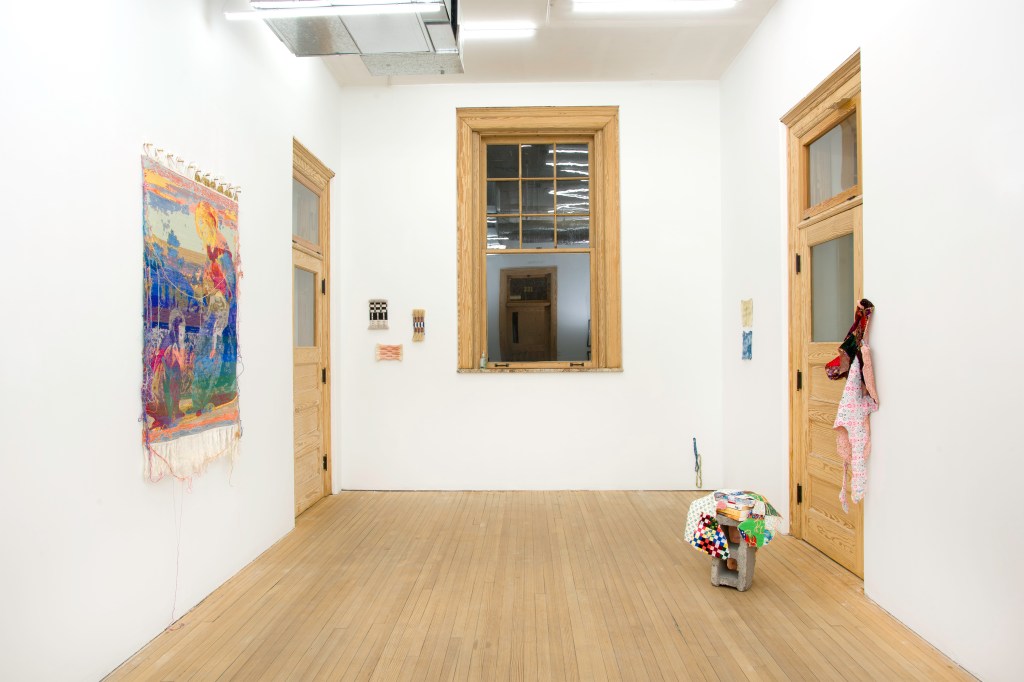
Phantom Haptics looks to the future of textiles, asking what the art form has become at a time when their innately somatic qualities are estranged from our hyper-digitized perceptions. The selected artists use textiles to either distance or ground themselves firmly within three modes of usage. Textiles are first and foremost sensory objects that require a great deal of manual manipulation in their pro duction and are activated through touch. Textiles also function more metaphorically as connectors – works that are communally made and pay credence to a specific group, “touching” many through existing singularity. Finally, textiles have increasingly been used in contemporary work to offset other physical mediums and confuse the distinctions between them, encouraging new ways of making and furthering the definitions of multidimensional form.
This scope for an exhibition is admittedly braod and comples, Works presented in Phantom Haptics, are appropriately rich and layered, both physically and metaphorically.
Stephanie Robinson’s unusual sculptures confound interpretation and definition, evading our at tempts to identify what materials they are made of and how they are visually balanced and struc turally sound. The respective material qualities of felt and stone seem to switch back and forth and to synthesize with one another. Her Instagram handle, Squishy Stone, hints at the material humor embedded in their creation. Aaron McIntosh’s quilted silhouettes of lovers in flagrante betray their as sumed purpose in display. Rather than being flat, utilitarian objects, his quilts become sculptural forms that cheekily cascade over gay erotica,and tumble down from a hooked, fleshy finger. In presenting them to viewers in this way, McIntosh also partially obscures what exactly his works portray to an un assuming eye.
Hope Wang Jordan Craig’s painting enlivens geometric patterns used in Cherokee bead work and saddle blankets. Re-purposing the horizontal repetitions commonly found on a flexible, tanned hide material for the canvas, Craig nods simultaneously to a larger cultural tradition and a singu lar person, and also disjoints and warps conventional conceptions of what a textile is and can be. Though existing outside of the technical definition of a textile, Craig’s work very much reads as one. The work took shape in part as a kind of portrait of her sister, who often experiences “head in the sky” moments.
Painting and weaving may seem to have a paradoxical relationship, though curiously another artist in Phantom Haptics marries the two. John Paul Morabito has taken an image of the Madonna and Child, from a well known Italian renaissance work by Sandro Botticelli. As detailed by the artist, works from his Magnificat series seek to enliven approaches the Madonna through queer sensibility, offering a kind of queer grace. Morabito takes inspiration from T’ai Smith, who has situated weav ing as a tangent of art. Moribito uses the tangent as a queer methodology to craft an ontology on tapestry. Employing camp sensibilities, the artist considers the fallen glory of tapestry to re-orient holy images within a queer cosmology. Appropriation, mutation, and decadence are manifested in the weaving, at once joyful and sobering. Viewers are invited to consider the ongoing relationship of control and persecution imparted by the Catholic church upon queer bodies and communities for over 2000 years. Moribito’s texiles become queer bodies themselves in a way, displayed in florid, un ashamed humanity.
The queering of textile traditions seen often in this exhibition, which were often very strictly gendered historically, is overtly presented by wonderfully explicit works by James Mullane. Again referencing an art historical theme seen in colloquial western artists like Georgia O’Keefe and Robert Mapplethorpe, Mullane substitutes various flora for images of the anus and penis. Selections from his Immoral Garden series are decadent celebrations of gay sex. Many of the images were inspired by pornographic scenes.
Image appropriation is echoed in the appropriation of discarded plastic by Haynes. Materials such as a discarded lobster line, a New York times plastic bag, and netting are seamlessly incorporat ed into her intimately scaled weaving. Haynes creates intimate moments to consider new material explorations. By integrating plastic with more natural fibers, Haynes creates an odd juxtaposition be tween materials that are fleeting and easily degrade with time (an age old problem for textiles) and a material that stands against it.
The usage of a temporal medium to address themes of waste is something artist Hope Wang is also interested in. Wang digitally manipulates imagery from desolate sites of industrial detritus – like construction sites and empty parking lots. The stark ugliness of urban ruins and abandoned sites of become poignant reminders of human civilizations and human stains.
On the opposite end of the spectrum, Aaron Storm’s works are meditations on the ultimately fragile and temporary nature of most textile based works by investigating the medium through raw source materials. Engaging with an instructional lineage of Japanese and Appalachian artisans, these explorations of non-traditional pigment application on silk mawata function as meditations on the impossibility, inevitability, and tension of death, dying, and grief. Each layer of unspun silk is a single, unbound cocoon of a silkworm allowed to survive for use as breeding stock; rather than being boiled and reeled, these imperfect cocoons are stretched over a frame and used for ‘raw silk’ pro duction, leaving a physio-temporal record of transformation, and a brief glint of life in defiance of
death. This tension between the desperate compulsion to clutch life against the chest, and the inev itable stilling of a body in death is further embodied through the application of chlorophyll, and the spinning of the silk. Resulting from the inherent instability of the pigment, the image will fade quickly upon exposure to light, changing the object over the course of the exhibition.
Curated by Derrick Velasquez and Lauren Hartog
 Friend of a Friend