
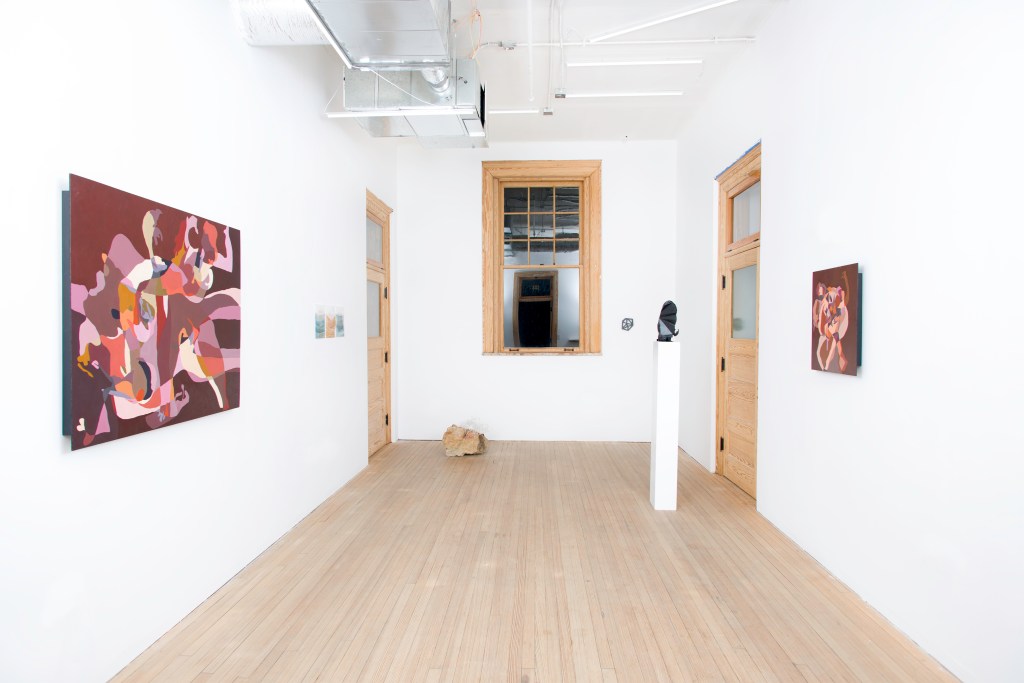
Lonely on the Mountain explores artist Grace Kennison’s interest in the conceptualization of white women and their relationships with the land through figural representations and depictions of the Colorado landscape. Her artwork fabulates white women suffering in embittered relationships with nature, animal companions, other women, and God. Land is fundamental to our identity, memory, and spirituality, seen both physical and psychological space. Dealing formally with landscape as a cultural and art historical construct Lonely on the Mountain exposes disjointed fantasies and failures of white women as caretakers of land. Pulling from the fraught history of well-known white landscape painters in the American West, the body of work expresses Kennison’s own desire to engage in reciprocal relationships with the land she was raised on. Presenting as mythological devices or cautionary tales of life on the ranch, these visions are chaotically interrupted by discord between natural phenomena, human construction, vanity, violence, and modernized tools of colonization.
Kennison’s paintings portray white women as contentious winged beasts sporting feminized cowboy couture that overwhelm the narrative of the land. This critique of contemporary pop cultural references breaks down images that are recirculating and romanticizing the aesthetics of rural life, cowfolk culture, and the West. For example, Kennison uses angels and angel wings as a motif in her works. This could be understood as a sort of perversion of the woman resembling an angel in John Gast’s 1872 painting “Amer ican Progress.” Gast’s well known work depicts westward expansion in the era of manifest destiny as a benign uplifting transformation of the natural world into civilization. Gast’s allegorical use of white women as the supposed congenial domestic force is indicative of the role white women were expected to play in colonial expansion.
As the values of capitalism, such as privatization of property and the elimination of communal wild space, were spread westward by white settlers so too were white supremacist genocidal policies targeting Indigenous Nations.
The social position of white women in this ongoing process of settler colonialism is important in contemporary conversations around the disenfranchisement of Indigenous peoples and ecological disaster. Parallels between the historical romanticism of the American West and European colonial cul ture’s infatuation with white purity and standards of womanhood are pertinent to current systems of power in the U.S. and efforts to dismantle them.
Grace Kennison is a visual artist and painter exploring female-centric visions and stories of trauma, resis tance, and of women’s complicated history with western land. Born in the foothills of Northern Colorado, she grew up in the bed of the Rocky Mountains outside of Fort Collins, where she spent much of her time
cultivating her talent and practice. In the spring of 2018, she graduated with a BFA with a concentration in drawing from Colorado State University’s Visual Arts Department, and has since committed to developing her independent practice as a painter. Today, Grace lives and works on Oĉhéthi Šakówiŋ, Cheyenne, Arapaho, and Ute land in Denver, Colorado.
Curated by Derrick Velasquez and Lauren Hartog
 Friend of a Friend